The Wright Family Name
By Debra Staab · July 2026 · Volume MMXXVI, Number 7 · Page 20 · 6 min read
It’s not unusual for people to choose a beautiful and serene location for their retirement, perhaps a location like the Santa Cruz Mountains. That is the plan that Reverend James Richards Wright had back in 1869, when he acquired 100 acres of land at the Summit from Lyman Burrell. The Wrights and Burrells had been neighbors in Ohio, and their families were related by marriage when James’ sister Clarissa wed Lyman in 1839. Burrell had staked his claim at the Summit in 1853. Sources say that Wright paid $600 for his property, possibly as part of a debt-repayment scheme between the two men.
The Wright Family. James Wright was a graduate of Oberlin College and completed further studies in Greek, Latin, and theology in Elyria, Ohio, where he was ordained as a Congregational minister. His older brother, Elizur, was a well-known mathematician and abolitionist.
James met Sarah Holmes Vincent at Oberlin and married her in 1844. The couple had 10 children, eight boys and two girls. Sadly, two of the boys died during childhood. After decades of ministry at Congregational and Presbyterian churches, James retired. With his health failing, he dreamed of better climates and decided to move his family to California. He sent his two eldest sons, Elizur and William, ahead to establish a homestead near the Burrells.
James and the rest of his family arrived a year later to set up permanent residence. The Wrights quickly planted fruit trees and vineyards. Within a few years they built a large house. They also constructed a hotel as a summer resort, complete with its own stagecoach stop, which they christened “Arbor Villa.” These buildings were located just north of the Burrell estate, on the Santa Clara County side, at Summit Road and Loma Prieta Avenue.
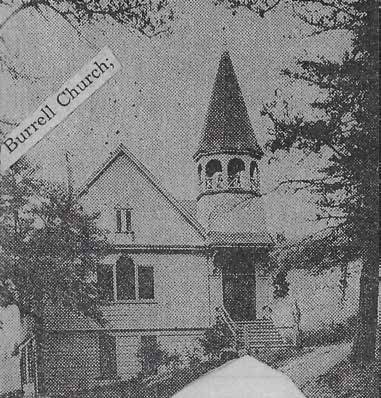
The Wright family eventually farmed over 134 acres of fruit and took on leadership roles in the community. Reverend Wright served the Skyland Church for some time. In 1893, he constructed the Wright’s Presbyterian Church (sometimes called Burrell Church) at the foot of Loma Prieta Avenue. Both James and Sarah ran Arbor Villa, and their children were also quite successful. William was a superintendent, and his brother Albert was a foreman at the San Jose Fruit Canning Company. Henry was president of the Union Saving Bank in San Jose and married Mary Murphy, the daughter of then- San Jose Mayor, Bernard Murphy. Sumner moved to the San Bernardino Mountains and established a town called Wrightwood, which is now a ski resort. Lucy married U.S.
Army Captain Albert Whittlesey and moved to Portland, Oregon. Frank married the daughter of railroad magnate Alfred Davis. Charles was an educator who died in 1889 at age 31. Eli worked on the ranch, and Clara continued living at Arbor Villa until 1940.
The Town of Wright. In the mid-1870s, the South Pacific Coast Railroad began the arduous task of building a rail line between San Jose and Santa Cruz through the Santa Cruz Mountains. A one- mile-long tunnel was required along the Los Gatos Creek basin north of Austrian Gulch. It happened to sit on Reverend Wright’s land. Wright gladly sold the right-of-way to the railroad since it offered a way for him to easily ship his fruit, and the trains would bring tourists to his hotel.
Wright’s decision completely changed the neighborhood. Tunnel construction brought in hundreds of men who quickly built a labor camp including bunk houses, storage sheds, a blacksmith shop, and a saloon. The saloon, said to be more like a dugout, was run by the construction foreman O.B. Castle, who named it “The Tunnel.” The Tunnel quickly earned a reputation as the roughest, toughest, rowdiest place in the Santa Cruz Mountains to have a drink. One local described it in these terms, “The Tunnel made the Barbary Coast look like a Sunday school picnic by comparison.”
During tunnel construction, a heavy swing with a pick released a seam of natural gas which quickly filled the cavern. In a flash, the entire chamber was ignited by the burning torches of the workers. The resulting blast was so intense that it blew men straight out the tunnel hole, flipped a ten-ton compressor fifty feet away, and destroyed Wright’s Blacksmith Shop, 200 feet from the tunnel entrance. Only the foreman survived.
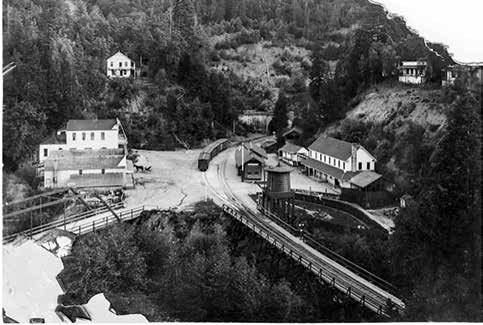
In spite of the explosion, construction continued, and the first train steamed through Wrights Tunnel (also called the north portal of the Summit Tunnel) in 1880. Almost immediately, the stop became a major shipping hub, especially for fruit, wine, and lumber. A village sprung up on the opposite bank of the creek with a train station, post office, general store, and visitor accommodations. Many homes and resorts dotted the surrounding hillsides.
A man named A.J. Rich purchased the town property with plans for expansion. James and Sarah Wright's two daughters
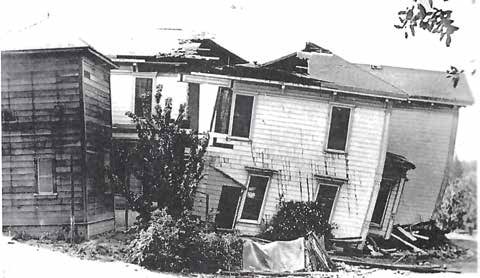
coffin was hammered in when Arbor Villa burned to the ground in the summer of The Legacy of Wright. Reverend Wright died in 1897, and Sarah in 1908. Both are buried at Oak Hill Memorial Park in San The family name lives on as Wrights Station Road and Wrights Station Vineyard and Winery, both located on what was once Reverend Wright’s land. You can access the original town site by driving north on Morrill Road from Summit and then turning onto Wrights Station Road. At the end of the road, you'll see the 1914 bridge across Los Gatos Creek. Beyond this sits the San Jose Water Company land as well as private property. Public access is not follow the trail you can see the remains of the North Summit Tunnel portal and what’s left of a retaining wall. Although the town site is barely visible, the historical significance of Wright lives on in the Santa The Arbor Villa Hotel and Wright's home, across Summit Road from the Burrell residence, was split in half during the 1906 earthquake.
Squire General Merchandise Store, 1910 Unfortunately, a fire in 1885 completely destroyed the existing community. Rich soon rebuilt, and by 1895 a new version of Wright, sometimes called Wrights Station, began in earnest. In 1904, the town was A travel brochure from the time described the area’s appeal: “The scenery is everywhere beautiful, and within the past few years in search of sites for homes have climbed on mountain sides, searched out the springs, and made winding roads around the knolls, up the canyons, and to the very summits. The brush has in many places been cut away, and trees and vines cover knolls and hillsides. White houses stand on projecting points far above the canyons, or nestle in groves of trees on the benches.”
Up through the early 1900s, the town continued to thrive, adding a water tower, school, and freight depot. Sunset Park was developed to offer picnic grounds, barbecue pits, and hiking for thousands of visiting tourists. Picnic trains and the Suntan Special hauled 10 train cars full of 50 people per car. French bread, salami, cheese, barbecued lamb, beer, and wine provided sustenance.
The 1906 earthquake caused significant damage to the tunnel and tracks, which took a few years to repair. Town revenue declined, and the beginning of prohibition in the 1920s took its toll on local wine markets. The Glenwood Highway also opened at that time and drew tourist and business traffic away from Wright. Charles Henry Squire’s general store closed in 1923 after twenty years in business, and the school shut down in 1928 due to lack of students.
By the 1930s, Santa Cruz Mountain forests were logged out and the lumber industry took a nosedive. The Wright Railroad Station closed in 1932, and the San Jose Water Company purchased the land in 1936. Only 50 residents remained by 1940 when the railroad was officially abandoned.
Automobiles replaced trains in the Santa Cruz Mountains when Highway 17 opened the same year. The final nail in the town’s