The Historical Schultheis Family
By Debra Staab · February 2026 · Volume MMXXVI, Number 2 · Page 20 · 7 min read
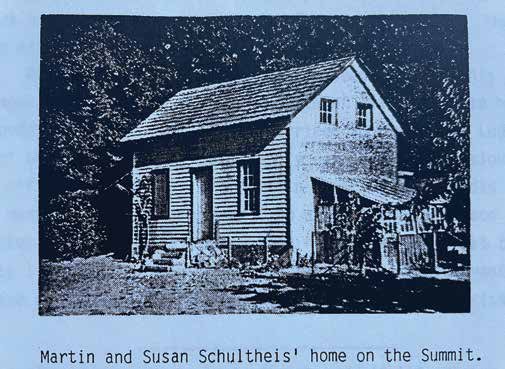
John Martin Schultheis (pronounced shool-tize) and his wife Susan Byerly Schultheis were major contributors to the early development of pioneer life in the Santa Cruz Mountains. The couple arrived at the Summit in 1852 in an oxen-drawn wagon loaded with all of their personal belongings. The trip up the hill from Los Gatos took three days of pushing through brush and chaparral. There were no roads at the time, only old Indian and Spanish trails.
John was born in Bavaria in 1826, where he became a skilled cabinet-maker and farmer. He immigrated to the United States and initially settled in Ohio. There, he met and married Susan Byerly, also from Bavaria. John and Susan joined a cross-country wagon train in early 1852 and headed for the West Coast.
The couple had planned to claim property in Santa Clara Valley, but learned that much of the land had already been staked and the rest seemed to be under dispute. Instead, they headed into Santa Cruz Mountains and grabbed a large plot of flat land by a lagoon near the intersection of what we now call the Old Santa Cruz Highway and Summit Road. Here, they would plant orchards and make a life among the redwoods.
At the time, there were very few other living at the Summit. The Native American locals passed through the area as they traveled between the mountains and the coast, but did not make permanent settlements here. The Schultheis’ only neighbor was Charles McKiernan, an immigrant from Ireland. Mountain Charley built his first cabin about two miles up the road from them, having arrived a year earlier in 1851. Travelers passed over the summit on their way from San Jose to Santa Cruz.
Both towns were established much earlier during Spanish rule, the former in 1777 and the latter in 1791. Los Gatos was little more than a crossroads by Forbes Flour Mill until the late 1860s. John was a builder, and he soon constructed a sturdy log cabin. It was held together with mortar made from lime mined near Felton. The original cabin, now covered with siding, is still in use and is believed to be the oldest structure in the area. The family cleared their land and planted orchards, vineyards, and grains.
The couple had four children: Martin, Edward, Frank, and Alice. Helping the Community. Susan Schultheis was a nurse and midwife who trekked up and down the mountain to tend to people’s ailments and assist with births. She traveled alone in all types of weather as far as Boulder Creek. When a stageline started running past the Schultheis home, Susan fed the passengers biscuits, toast, and coffee while her husband tended to their horses.
John and Susan both helped nurse Mountain Charley back to health after his grizzly-bear attack. (See article on facing page.) One story about Susan shows her bravery in the face of danger. She was home alone when three rough, heavily armed villains came to the door demanding food. Susan calmly served them, and they soon galloped away. She later found out that the men were escaped prisoners from Australia and that they were being hunted by a local posse. The posse soon caught up with the men who were unceremoniously executed on the spot, their bodies left unburied.
Between the Schultheis’ arrival and the 1880s, many other pioneers staked claims on the Summit including the Burrells, the Wrights, the Meyers, and the Chases. John’s orchards had matured and were producing a lot of apples, pears, and other fruit. His example led many others to cultivate fruit and grapes, and it became a lucrative industry for the community.
In 1880, the railroad began operating, with stops at Wrights and Laurel. John constructed a 3.5-mile-long dirt road from his property to Laurel for the purpose of shipping his fruit to market. Alice Schultheis Marries Volney Averill.
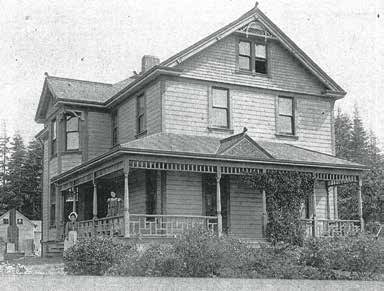
John and Susan’s daughter, Alice, married Volney Averill in 1873 and took over the land on the north side of the homestead. They moved the original cabin to the back of the lot and built a large Georgian-Victorian Alice and Volney Averill's Georgian-Victorian home
home near the front of the property in 1895. The couple eventually had seven children. This parcel was sold to the Taylors, then the Masons. It is today known as the Mason- Taylor Ranch. The large home was destroyed during the 1989 earthquake. The Loma Prieta Museum holds their annual Family redwood grove where Averills were married.
The Summit Opera House. In 1885, the Schultheis donated land to the Patchen Social Club to build a recreation center. Volney Averill was a founding member. The large 40-by-75-foot building was named the Summit Opera House. The hall hosted plays, dances, operas, and other social gatherings.
Two of the Schultheis boys were musicians who often performed there. The builders of the Summit Opera House included a special feature. They placed heavy wagon overload springs under the dance floor joists so the entire floor responded to the rhythm of the dancers. Locals became regular attendees, and people came from as far away as Santa John Schultheis died in 1896 at the age of 74, and Susan passed in 1907 at age 78.
Both are buried at the Santa Clara Mission A Schultheis Anniversary. Gerry Park is a direct descendant of the pioneering family. In 2023, he hosted a 150-year anniversary celebration for Alice and Volney at the Mason-Taylor Ranch. Several family members and a few local historians came to pay their respects. Gerry shared old photos, coins, jewelry, and stories about his heritage.
He showed an historic octagon-barrel muzzleloader rifle that was used to shoot grizzly bears. He also brought out a silver chalice that was given to Alice and Volney by their daughter Bessie and her husband Billie Romes on their 50th wedding anniversary.
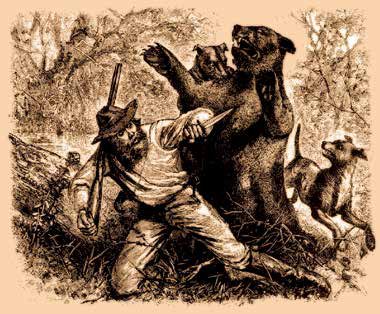
The chalice is a family heirloom. paints a clear picture of John and Susan Schultheis. They were adventurous, industrious, caring, and productive members of our community. They leave behind a legacy on the Mason-Taylor Ranch and a A dramatic fight between Mountain Charley and a large grizzly bear occurred on May 8, 1854. Both John and Susan Schultheis took care of Charley after the attack, and later gave an account of the brutal incident to the Santa Cruz Sentinel.
It seems that Charley and a friend named Taylor went hunting and had killed a couple of deer. Suddenly, Charley spotted a massive grizzly bear eating wild oats across a hollow, and he set about to shoot and kill it. They packed powder into their muzzle-loading rifles (which could only fire a single shot at a time) and made ready to hunt. Before the two men could get in position to fire a shot, the bear charged at them. It probably smelled blood on their hands from the deer.
Both men then fired their rifles, but the McKiernan smashed his rifle into the bear’s ribs, which bent the barrel and rendered the gun useless. The bear got angry, rose up on its hind legs, wrapped its front paws around Charley’s head, and bit down.
One of the bear’s teeth caught Charley’s right eye, and the other tooth pierced his left temple. When Charley raised his arm, the bear bit that too. Then, it charged at Taylor. Taylor ran for his life and fell into the wild oats, which hid him from the predator.
Finally, the bear leapt over McKiernan and ran growling into the woods. Taylor ran for John Schultheis, Taylor, and a few others went back for Charley. They wrapped him in a blanket, put him on a mule, and got him home in one piece just before sunset. John bravely agreed to ride into San Jose to get a When Dr. Bell removed the dressing to examine the wound, a chunk of Charley’s skull stuck to the bandage and they could see his bare brain pulsing. The doctor prescribed a metal plate to cover the gash in Charley’s head. It was made from a silver peso and arrived the next morning.
Unfortunately, it was too small and a second silver plate had to be made. The next day, Dr. Ingersoll came up the hill to perform the operation using only chloroform as a pain killer. They say that Charley barely flinched.
For the next few months, Susan nursed Charley while John tended to the garden and livestock. Charley’s eyesight returned in a month, but the wound refused to heal. By chance, a doctor from Santa Cruz stopped at Charley’s for supper on his way to San Francisco. He took one look at the injury and announced that the plate had to be removed immediately, which he proceeded to do. Finally, the gash healed and Charley The Schultheis refused to leave him alone until he could handle his own affairs.
During this period they also had to care for their own homestead, two miles away. Charley got back on his feet, but suffered from painful headaches over the next few years. His doctors became quite concerned, and on their recommendation, he allowed them to reopen the old wound. They discovered and removed a wad of hair which had been caught inside Charley’s head. After surgery, his pain diminished, and even with a disfigured face, he lived a relatively normal Charley later married, moved to San Jose, and had seven children. He died in 1892 at the age of 66, some 38 years after the bear