Lago Lomita Vineyards
Bottling Season
By Robin Porter · May 2026 · Volume MMXXVI, Number 5 · Page 14 · 2 min read
We are already planning for next year’s harvest in the vineyard, so it’s time to bottle the wine that’s been aging in barrels in our barrel room. Bottling equipment is very expensive, so most small wine producers use a bottling service. This doesn’t mean we lug barrels down to a warehouse. Here in the mountains, the bottlers come to us.
A winemaker usually consolidates all the barrels of one type of wine into a single tank before the bottler gets to the winery. The output of that tank is a long hose that can exit the barrel room and reach outside. The bottler parks a semi-truck where it can hook up to the hose. The winemaker connects the hose from the tank to the semi, and the fun begins.
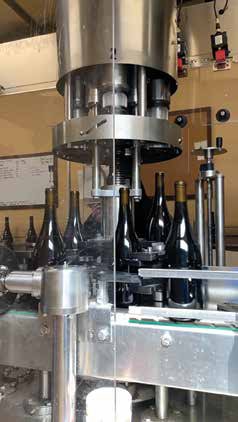
On one end of the truck is a conveyor that takes in empty, clean bottles. We order bottles well in advance after considering how much of each type wine is in our barrels. Each wine has a traditional bottle shape. Standing on the receiving end of the semi-truck, we place empty bottles on the conveyor. The conveyor moves this stream of bottles up to the first station. The wine is pumped out of the tank, down the hose, into the semi, and into the bottle. After the bottle is filled, it advances to the corking station.
Corks are special, too. There are different grades of natural cork or synthetic cork, and you need to be sure that the corks are correctly sized for the bottles. The corking station is pretty self-explanatory, but there are variables, like the amount of pressure needed to insert the cork. Foil is applied after corking, then the bottles advance to the labelling station.
Labels can be complicated. The government requires review and sign-off on all label designs. Once approved, they go to a printer and we finalize colors, graphics, label shape and size, and adhesives. The cut labels are put onto a reel of label tape that is loaded into the bottling truck. As each label is spun onto the bottle, a counter is incremented.
The counter is the official count of how many bottles are filled, corked, and labelled. The official count is signed off by the bottling company and the winemaker. This is sent to the government as a record of what wine was bottled, for tax purposes. Wine production is highly controlled and regulated.
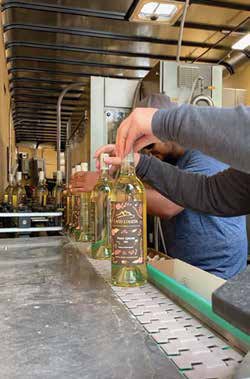
As the filled, corked, and labelled bottles exit this station, we take each one off the conveyor and load it into empty case boxes. When each box is full, we tape and label it. The boxes are stacked on a pallet and eventually loaded back into the barrel room or stock room for storage. The empty barrels are cleaned, sanitized, and made ready to be filled with this upcoming year’s harvest.
Watch out for the large bottling trucks on our mountain roads this time of year.