Last Call for Alcohol
By Debra Staab · January 2026 · Volume MMXXVI, Number 1 · Page 19 · 10 min read
Drinks all Around. The Pacific Coast Railroad brought hundreds of strong- muscled Chinese and caucasian workers to the Santa Cruz Mountains in 1877 to build a railroad tunnel at Wright’s. Upon arrival, the remote location sported nothing more than an old woodcutter’s shack. Within the first few weeks, the crew felled trees and built themselves bunkhouses, a cookhouse, several tool sheds, and most importantly, a saloon.
The saloon, said to be more like a dugout, was run by the construction foreman, O.B. Castle, who named it “The Tunnel.” The Tunnel quickly earned a reputation as the roughest, toughest, rowdiest place in the Santa Cruz Mountains to have a drink. One local described it in these terms, “The Tunnel made the Barbary Coast look like a Sunday School picnic by comparison.”
The underlying reason behind the constant drunkenness stemmed from a cocktail invented by Mr. Castle, which he called “Discovery.” The recipe was simple: add four tablespoons of water to one gallon of whiskey and down it all in one sitting.
Things changed when women arrived at Wright’s. They didn’t like the incessant drinking, swearing, and fighting at The Tunnel and soon took matters into their own hands. To combat the debauchery, the women banded together and armed themselves with chairs and brooms, which they used to swat down the riotous perpetrators. Apparently that worked well, at least until the next night.
The Tunnel may have been the most notorious watering hole in the Santa Cruz Mountains, but it wasn’t the only one. Just a few miles north, the logging town of Alma had a dozen saloons, including the Forest House. On the southwest end of the mountains, the town of Boulder Creek, with a population of 750, featured 16 taverns by the early 1900s. Drunken lumbermen regularly staggered through the streets of Los Gatos and Saratoga (then called McCartysville). It’s estimated that in San Francisco there was one saloon for every 96 residents by the mid-1850s.
Alcohol consumption in California was at a high point between 1850 and 1900 largely due to the Gold Rush, that lured around 300,000 get-rich-quick opportunists to the west coast. Records indicate that alcoholic intake averaged 7.1 gallons of hard liquor per person annually. This amount translates to about 2.5 ounces, or close to two shots per day. Whiskey was the favorite but rum, wine, beer, cider, punch, and other alcoholic concoctions were consumed at breakfast, lunch, and dinner.
During this period, saloons and taverns served more than liquor. They provided a location for socializing, networking, and even job hunting. Society recognized the importance of these business owners and placed them at an equal or higher social status as clergy. Reports show that most taverns were quite lucrative with claims of liquor profits as high as $1000 per day.
Historic Alcohol Usage. Alcohol is a clear, volatile, flammable liquid produced by the natural fermentation of sugars. It is the intoxicating ingredient in wine, beer, and spirits. Alcohol is such a strong liquid that it is also used as an anesthetic, in cleaning solvents, and as fuel.
Evidence shows that fermented beverages existed in China as early as 7000 BCE. and in India and Babylonia around 3000 BCE. The Greeks honored the wine god Dionysus and the Romans worshipped Bacchus. Some pre-Columbian Native American communities developed fermented drinks such as “chicha” made from corn, grapes, or apples.
The use of alcohol for medicinal purposes developed in the 1500s. To expand the grain industry, the British encouraged the distillation of grains during the early eighteenth century. The plan resulted in public consumption of 18 million gallons of gin annually. Alcoholism became widespread.
The many downsides of excessive alcohol consumption became much more apparent during the second half of the nineteenth century. Heavy drinking often led to fights, accidents, and threatening behavior. People became addicted and wasted their hard- earned dollars on spirits over their basic needs. All of this contributed to high rates of injury and death. Some took notice of the negative side effects, especially women, who set about to temper this destructive behavior.
The Temperance Movement. Early attempts to curb alcohol abuse in California came in the form of state government sales taxes on liquor and licensing fees on proprietors. These measures proved to be largely ineffective, which spurred further action by communities.
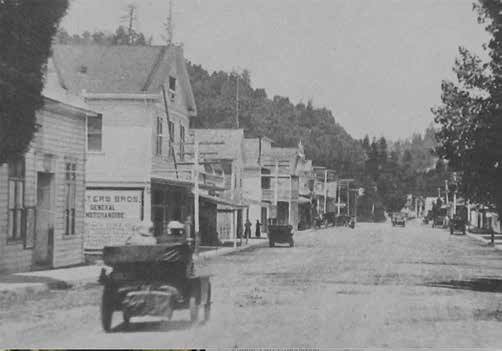
continued on next pageDowntown Boulder Creek
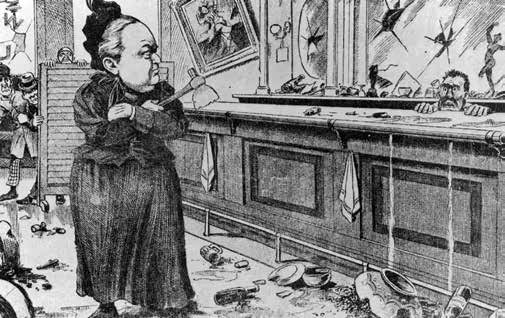
The Woman’s Christian Temperance Union (WCTU) was initially established in Ohio in 1883. Their goal was to bring social reform by linking religious beliefs to secular activities. Because alcohol abuse often hurt women and families through domestic violence related to alcoholism, the women sought to control the availability of liquor. Their movement pushed for “a sober and pure world” through abstinence, purity, and evangelical Christianity. The plan to eliminate alcohol sales became known as One particularly active member of the WCTU was Carrie Nation, also known as Hatchet Granny. Nation, who often dressed in black and white clothing, was known for bursting into saloons, singing, praying, hurling bible verses at the clientele, and taking her hatchet to all of the bar fixtures and bottles that she could reach. Although she was jailed numerous times, she always paid her fines and continued her mission.
By the late 1880s, the argument over whether to sell alcohol or prohibit it came to a boil. Those in favor of selling liquor were known as “the wets” and included town governments, saloon keepers, and those who liked to drink. On the opposing side, the prohibitionists were referred to as “the drys” and were championed by the WCTU with support from those who did not like drinking. One of the first WCTU groups in In June of 1889, Los Gatos passed an ordinance that made it illegal to serve alcohol, thus making it the first town to go completely “dry.” Many were unhappy, and just two months later, another ordinance restored liquor sales at saloons but imposed a high permit fee. The debate raged on for the next 15 years until the issue was finally put to the public vote. In 1906, 54 percent of voters (only men at the time) supported Prohibition, and Los Gatos became the second city (Palo Alto was first) to go “dry”
by popular vote. Four years later, the rules were loosened to allow the serving of liquor The Boulder Creek branch of the WCTU was formed in 1892. Their first success at cleaning up the town was to acquire a large reading room to counter the town’s lust for liquor. Their anti-saloon agenda included “blue laws” which forbid alcohol on Sundays, quarterly liquor-license fees, and editorials in the Mountain Echo newsletter.
Over the next decade, these steps reduced the number of saloons by 50 percent. In 1908, Prohibition was officially approved in Boulder Creek by a vote of 115 to 103. For the drinking crowd, the decision was little more than an inconvenience as they simply traveled a short distance to the next town to imbibe. However, the loss of revenue was great and in 1915, the public voted to end Prohibition. Just five years later, national Prohibition would commence under the 18th Amendment which prohibited the manufacture, sale, and transportation of alcohol across the United States. Note that it was not illegal to consume liquor, if you Moonshining, Bootlegging, and Rum- running. Aptos became a dry community in 1912, but not everyone was on board.
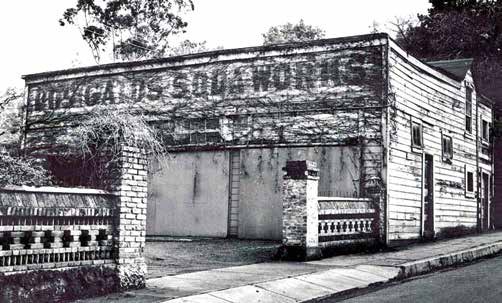
One elderly saloonkeeper refused to shut down and ended up in a Santa Cruz jail. A local historian reported that Santa Cruz laws around drinking were so lax that the man was allowed to serve his sentence in an unlocked cell while playing cards and drinking whiskey The Los Gatos Soda Works bottling plant was fined $300 for selling liquor in 1912.
There were also unsubstantiated rumors that the company had used their facilities to bottle After the National Prohibition Act became the law of the land, the California coast quickly turned into a mecca for the transport and sale of illegal booze. Through a sophisticated network of large ships that anchored up to 12 miles offshore, combined with speed boats that easily outran Coast Guard vessels, up to 500 cases of Canadian gin, brandy, Scotch, vermouth, and whiskey could be moved surreptitiously, usually in the dead of night. There were well-known drop-zones in Capitola, Pleasure Point, the Santa Cruz Wharf, Davenport Landing, and Half Moon Bay. This was big business, and participants could earn up to $10,000 per Once on land, contraband was stored in sea-caves, with sympathetic neighbors, and even in the now defunct Cement Ship.
Friendly locals would move the goods from the shore to inland locations like San Francisco and San Jose. The whole scheme was referred to as rum-running (the term was originally coined from smuggling rum from the Caribbean to Florida). In general, rum-running referred to moving contraband over the water while bootlegging meant transporting illicit goods over land.
Mountains, small-time moonshiners built stills to manufacture batches of almost pure alcohol, also called grain alcohol or “white lightning.” Typically made from corn-mash, sugar, water, and yeast, the output was 190-proof ethyl alcohol. The concoction went into five-gallon cans which bootleggers then distributed around the area, including to hotels in Santa Cruz and Capitola. Local proprietors bribed law enforcement to “play along” and “allowed” the occasional bust so that it all looked legitimate. Shipments also went to the numerous illegal speakeasies that popped up all over the area. The term “speakeasy” derives from “speaking easy” or in hushed tones to avoid attention.
Many moonshiners produced decent quality liquor, but others weren’t so careful with their workmanship. With no safety standards in place, some producers cooked up bad-tasting, unhealthy, and even
poisonous products. Some rotgut was made from denatured alcohol by intentionally adding poisons such as gasoline or methanol. You had to really trust your bootlegger. Winemaking Woes. Successful wineries were especially devastated by Prohibition. The new law did permit families to produce up to 200 gallons of wine per year for personal consumption. However, winemaking had become a lucrative business in the Santa Cruz Mountains, and the new restrictions threatened to cripple the industry.
Records show that in 1875 the Santa Cruz Mountains had 262,275 vines (300 acres, 121 hectares) and were producing 70,000 gallons of wine a year. Vineyards included well-known names such as Paul Masson, David Bruce, and Martin Ray. Other local names were Burrell at the Summit, the Jarvis brothers near Scotts Valley, the Burns family in Ben Lomond, Dr. Robert Tripp and Emmit H. Rixford near Woodside, and Pierre Klein and Osea Perrone at Monte Bello Ridge. The Catholic Church managed a winery at the Novitiate in Los Gatos. Under Prohibition, all of these popular vintners were jeopardized.
Thus was born the alternate industry of Paul Masson carried on making his “medicinal” Champagne, and the Novitiate continued producing sacramental wine. The Bergetto family in Soquel developed a bootleg winemaking process for Zinfandel and Charbono grapes that eventually became profitable. Small-time farmers sold do-it- yourself kits with grape juice, yeast, and In the 1890s, the Martinelli family initially focused on Champagne-style hard cider which won a gold medal at the California State Fair. During Prohibition they took a different approach, and cleverly invented non-alcoholic sparkling cider. By 1944 they were producing 600,000 gallons annually.
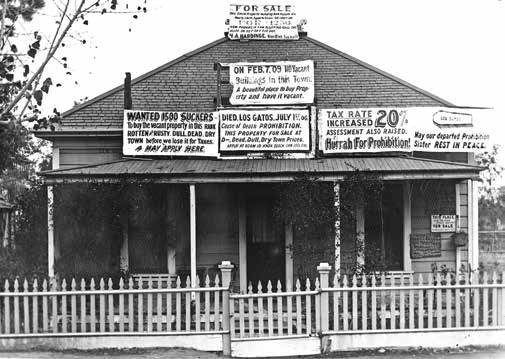
Even today, you can buy Martinelli’s in apple The End of Prohibition. Reports in the 1909 Los Gatos Morning Press stated that because of Prohibition, property values fell to an all-time low. Home sales and rentals were down significantly. People were moving away and few were moving in. The public knew that Prohibition was not working, and they were ready for it all to end.
The law that was meant to curb drinking and crime actually triggered gang wars which killed thousands and created organized crime syndicates. The quality of alcohol decreased but the amount consumed did not. shifted moderate drinking patterns with unhealthy binges, and arrests for drunkenness rose. Poisoned alcohol killed 10,000 Americans, mostly in the poor and In 1930, Prohibition was ruled to be unconstitutional by federal judge William Clark. Nonetheless, President Hoover vowed to make the law permanent during his reelection campaign in 1932. Hoover lost by a landslide and President Franklin D. Roosevelt called an end to Prohibition in 1933. The 21st Amendment formally repealed the 18th Amendment in December, 1933. Although beer, wine, and liquor sales were legal at the national level, it took until 1966 for all states to officially end local- prohibition laws, with Mississippi being the Even today, liquor laws vary from is now the social norm. A recent Gallup poll reported that the percentage of Americans who drink alcohol fell from 60 percent in 1997 to just 54 percent in 2025. Young adults now drink less than their elders, and 53 percent of all Americans say that even moderate drinking can be harmful to one’s health. Those who do drink are consuming less alcohol less frequently. About ten percent of Americans fight alcoholism, and there are nearly 100,000 annual deaths related to alcohol, with 15,000 of those in In 2013, the UK launched a program called “Dry January” to encourage people to reflect on their use of alcohol, especially after the previous end-of-year festivities. The goal is to avoid all alcohol for the entire month of January to counter the excesses of the holiday season. The idea persists even today.